











Remote Speed Control Systems for Karting Tracks
Modern commercial karting facilities demand an uncompromising balance between high-octane entertainment and proactive risk mitigation. Remote speed control systems for karting tracks have transitioned from optional operational tools to essential facility-wide safety architectures, allowing track marshals to govern fleet velocity instantly via multi-channel wireless telemetry. By leveraging radio frequency (RF), dynamic Wi-Fi mesh networking, and industrial IoT protocols, these systems empower operators to regulate individual or group kart speeds, enforce pit-lane speed governors, implement sector-specific yellow flags, and execute emergency fleet-wide shutdowns within milliseconds. For commercial track owners, selecting track management infrastructure engineered in synergy with elite Electric Go Karts and next-generation electric kart manufacturers ensures consistent signal integrity, optimizes battery cycle life, and reduces liability across competitive and family entertainment venues.
Advanced Fleet Telemetry: Wireless Speed Governance in Modern Karting
The modernization of commercial kart racing relies fundamentally on real-time bidirectional communication between a centralized track management server and onboard motor controllers. Traditional karting operations relied heavily on physical track marshals waving mechanical flags, a framework inherently constrained by human reaction times, blind spots, and driver non-compliance. In contrast, digital speed governance digitizes track control through high-precision transponders and telemetry modules directly integrated into the electronic speed controller (ESC) of the vehicle. When an incident occurs on track, the system bypasses human friction points, instantly de-throttling upstream vehicles or governing the entire grid down to a safe walking pace.
The Engineering Behind Wireless Telemetry and Speed Limiting
At the engineering core of modern speed control lies high-frequency radio telemetry, typically operating within dedicated 868 MHz, 915 MHz, or 2.4 GHz industrial bands governed by IEEE industrial telemetry frameworks. The central control unit interfaces with trackside antennas positioned strategically around the circuit perimeter to create overlapping zones of coverage. Each kart is equipped with a micro-receiver interfaced via Controller Area Network (CAN bus) or RS-485 architecture directly to the vehicle’s motor control unit (MCU). When a marshal initiates a speed override from a handheld tablet or fixed console, the command is packaged into an encrypted RF packet and broadcast to the designated transponder ID. The onboard MCU receives this instruction, overrides the driver throttle input through pulse-width modulation (PWM) attenuation, and applies regenerative motor braking or reduces phase current, seamlessly decelerating the kart without causing sudden wheel lockup or spin-outs.
Overcoming Signal Attenuation and Multi-Path Interference in Steel Facilities
Indoor karting facilities frequently encounter harsh electromagnetic environments characterized by extensive structural steel framing, reinforced concrete walls, and perimeter safety barriers that cause signal degradation and multi-path reflection. Forward-thinking electric kart manufacturers address these propagation challenges by deploying dynamic mesh network topologies and ultra-wideband (UWB) tracking beacons alongside standard RF broadcasts. Instead of relying on a single omnidirectional base station, track transceivers act as self-healing relay nodes. If a localized dead zone emerges due to structural shadowing, data packets automatically reroute through adjacent nodes to guarantee sub-50-millisecond latency. Furthermore, modern micro-controllers execute fail-safe watchdog routines: if an individual kart experiences total packet loss for more than a pre-configured duration (typically 500 to 1,000 milliseconds), the MCU autonomously degrades top speed to a conservative limp mode until RF handshake verification is re-established.
Active Collision Mitigation vs. Passive Pit Lane Throttling
Remote speed control systems distinguish between proactive track-wide pacing and micro-zoned velocity enforcement. Pit lane safety is perhaps the most crucial application of passive zoning; passive RFID or optical track sensors trigger automated speed limits as karts enter the staging apron, eliminating pit crew hazards irrespective of driver aggression. Conversely, active collision mitigation integrates geo-fencing algorithms. Track software maps out track sectors—such as high-speed sweepers, chicanes, and blind hairpins. In the event of a spin or collision in Sector 3, track marshals can isolate speed suppression exclusively to karts within or approaching Sector 3, while vehicles on opposite stretches maintain racing pace under local caution. This selective zoning drastically enhances track capacity, race flow, and customer satisfaction without compromising safety margins.
Evaluating Hardware Protocols and Safety Standards
Commercial track viability hinges on rigorous adherence to international amusement ride standards and engineering codes. Installing wireless throttle governance is not merely an operational luxury; it is a structural compliance parameter scrutinized by insurance underwriters and municipal safety inspectors worldwide.
Compliance with International Safety Regulations (ASTM & ISO)
Amusement facility operators must maintain rigorous adherence to ASTM International Committee F24 standards for amusement rides and devices, specifically addressing emergency stop functions, acceleration parameters, and patron containment. Furthermore, engineering designs must align with ISO amusement ride safety protocols (such as ISO 17842), which define safety-critical software architectures and functional safety levels. Remote speed systems meet these benchmarks through hardware redundancy: dual-channel emergency stop circuits ensure that even in the unlikely event of ESC processor failure, a secondary mechanical contactor or relay drops main battery power safely to the motor. Regular audits and diagnostic data logging within the control suite allow operators to provide tamper-proof telemetry records in the event of an incident investigation.
Integration Capabilities Across Mixed Commercial Fleets
Commercial entertainment centers rarely feature identical equipment configurations across their entire operational footprint. High-performance adult racing karts, intermediate junior karts, and recreational family attractions often share track facilities or operate in close proximity. A robust remote speed control ecosystem must feature modular architecture capable of interfacing with varying voltage buses, brushless DC (BLDC) motors, brushed permanent magnet motors, and lead-acid or lithium-ion battery management systems (BMS). High-tier electric kart manufacturers engineer their onboard electronic suites to accept universal digital inputs, allowing track operators to assign customized speed curves, acceleration profiles, and reverse-drive permissions according to driver skill levels, age brackets, or race types.
| Comparison Factor | Traditional RF Broadcast Systems | Next-Gen Mesh / UWB Telemetry |
|---|---|---|
| Signal Latency | 150ms – 300ms | < 30ms real-time response |
| Zone Precision | Wide track-sector approximations | Centimeter-level geo-fenced positioning |
| Bi-Directional Data | Limited (Unidirectional commands) | Full telemetry (RPM, temp, battery SOC) |
| Interference Resistance | Prone to multipath fading in indoor steel venues | Dynamic multi-node self-healing routing |
| Emergency Stop Failsafe | Manual trigger dependent | Integrated auto-fail-safe & watchdog loops |
Total Cost of Ownership and Operational Economics
Investing in integrated speed governance software yields profound financial returns beyond catastrophic liability reduction. The financial metrics of high-throughput karting tracks are governed by three primary operational variables: equipment turnover, mechanical component wear, and direct energy management.
Minimizing Mechanical Wear Through Dynamic Speed Stages
Uncontrolled aggressive driving, frequent barrier impacts, and panic braking contribute significantly to operational overhead. By deploying remote speed control with stepped power levels—for example, Level 1 (Beginner/Junior), Level 2 (Intermediate), and Level 3 (Pro/Master)—operators can progressively unlock vehicle performance as drivers demonstrate track competency. Restricting entry-level drivers to managed velocity bands reduces structural frame fatigue, bumper deformation, spindle bending, and tire flat-spotting. Electric motor regenerative braking, when integrated into remote control deceleration curves, recaptures kinetic energy while reducing mechanical brake disc and pad thermal wear by up to 60%, drastically extending routine maintenance intervals.
Battery Chemistry, Thermal Management, and Cycle Life
Electric commercial fleets undergo brutal duty cycles characterized by repetitive high-amperage discharge spikes followed by rapid turnaround times. When electric kart manufacturers integrate smart speed governors with onboard BMS units, the telemetry software monitors cell temperatures, voltage sag, and thermal thresholds in real time. If a particular kart's battery pack exceeds pre-configured thermal limits during an intensive endurance heat, the remote control system automatically feathers the peak power ceiling by 10% to 15%. This micro-adjustment prevents thermal runaway risks, eliminates nuisance thermal shutoffs mid-race, and prolongs overall lithium-ion battery lifecycle, directly saving operators tens of thousands of dollars in premature cell replacement.
Maximizing ROI in Family Entertainment Centers
While high-speed competition tracks demand intense speed zoning, family entertainment centers (FECs) and amusement parks require multi-functional attractions that cater to younger demographics with absolute mechanical safety. Broadening track utilization to include younger or novice riders without compromising safety requires equipment specifically built for high-impact durability and modular power delivery.
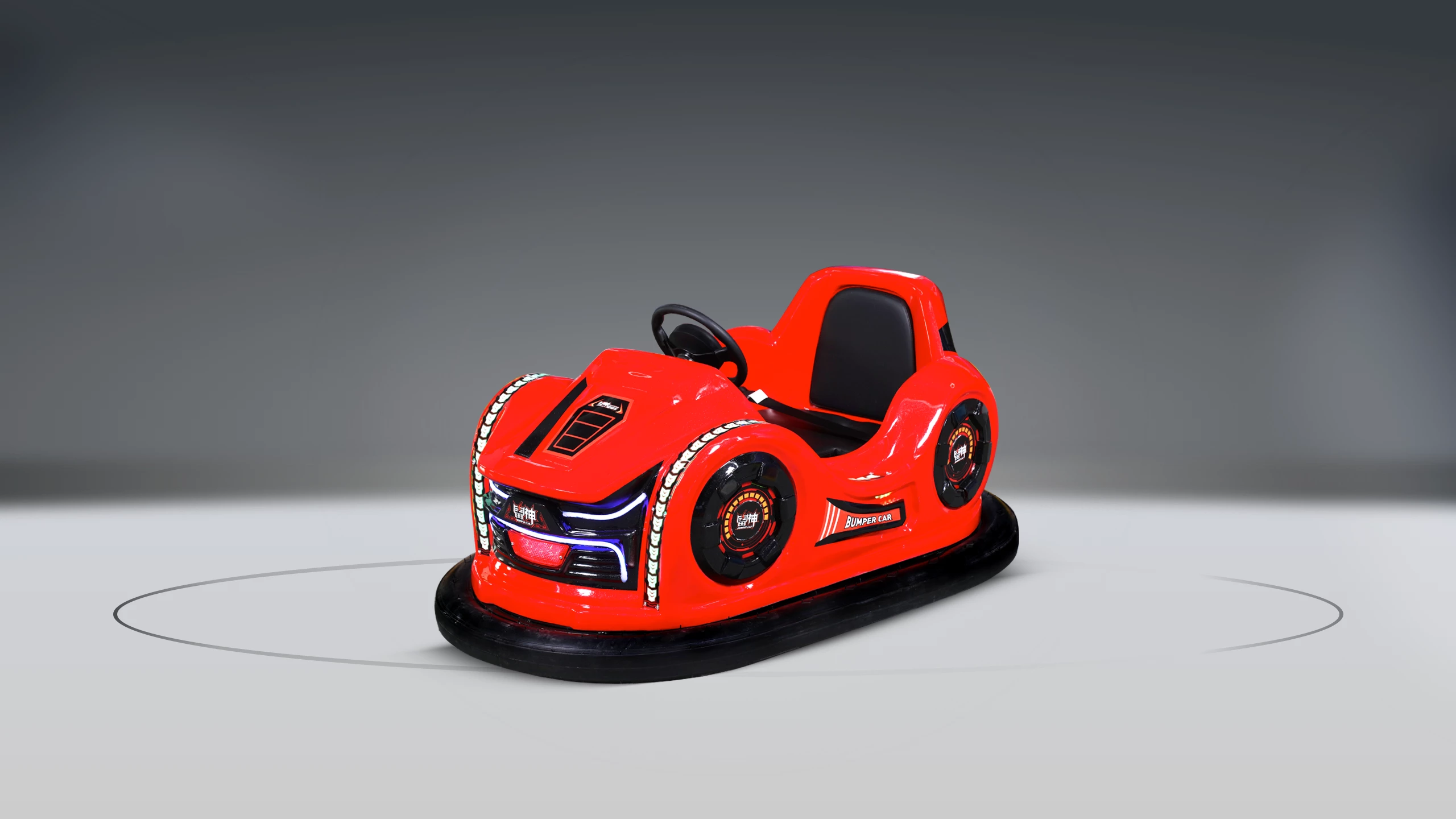
The Battery Drift Bumper Car With inflatable tyre represents an ideal operational asset for FEC operators looking to monetize controlled-speed indoor and outdoor surfaces.
The Battery Drift Bumper Car with Inflatable Tire with 650W steel gear motor, and high quality battery wich can becharged outside the car, the bumper car is ideal for amusement parks, family entertainment centers, build quality for safe, long-lasting fun.
Its industrial-grade 650W powertrain and exterior charging functionality allow park owners to cycle power packs continuously, eliminating charging bay downtime while sustaining predictable, safe drift dynamics that delight patrons of all ages.To explore state-of-the-art telemetry integration or request technical specifications for your facility, explore our fleet options or contact our engineering team directly at sandy@anchiyoule.com.
Frequently Asked Questions
How do remote speed control systems maintain communication integrity across large tracks?
Modern remote speed control systems employ industrial telemetry utilizing dynamic mesh networks, ultra-wideband (UWB) beacons, and multi-frequency RF transceivers. These technologies establish self-healing signal paths that circumvent structural steel, concrete barriers, and multi-path RF fading to guarantee sub-50-millisecond latency.
Can third-party remote speed systems be retrofitted to existing commercial karts?
Yes. Most advanced remote control telemetry units interface via standard CAN bus, RS-485, or direct pulse-width modulation (PWM) inputs into existing electronic speed controllers (ESCs), allowing track operators to retrofit both adult electric fleets and junior recreational karts.
How does remote speed limiting affect electric motor thermal longevity?
By smoothing out abrupt peak discharge demands and actively managing throttle ceilings when high temperatures are detected, remote speed systems mitigate excessive thermal build-up in motor windings and battery packs, significantly extending the operational life of the drivetrain.
What makes the Battery Drift Bumper Car With inflatable tyre suitable for controlled-speed family centers?
The Battery Drift Bumper Car With inflatable tyre combines a robust 650W steel gear motor with high-quality swappable external batteries and durable impact-absorbing tires, offering operators predictable velocity management, structural resilience, and continuous operational uptime in family entertainment venues.

The Cyclone RS 2025 is a high-performance electric ride-on car designed for thrill-seekers, entertainment centers, and commercial amusement businesses. Built with a durable ABS body and reinforced metal chassis, it combines strength, safety, and speed for a superior driving experience. With a 1200W mid-mounted motor (peaking at 3600W), advanced control system, and long-lasting 72V20AH LiFePO₄ battery, this ride ensures both powerful performance and reliability.
Whether for amusement parks, game zones, rental businesses, or personal recreational use, the Cyclone RS 2025 delivers unmatched excitement and durability.

Discover adventure with the ANCHI Kids Electric One-seater ATV, the perfect electric off-road experience for young explorers. Designed for safety and performance, this electric off-road go kart for kids offers unmatched thrills on any terrain. Its durable build and easy-to-use controls ensure a fun and safe ride. Ideal for budding adventurers, this ATV promises endless excitement. Explore the world with confidence with ANCHI’s innovative electric off-road solutions for kids.

The Battery Drift Bumper Car with Inflatable Tire with 650W steel gear motor, and high quality battery wich can becharged outside the car, the bumper car is ideal for amusement parks, family entertainment centers, build quality for safe, long-lasting fun.

Discover the future of fun with the ANCHI Spaceship Laser Battle Bumper Car! Designed for thrill-seekers, this kids bumper car offers an exhilarating laser battle experience. Parents and children alike will enjoy hours of safe, exciting play. Ideal for parties or everyday fun, it combines durability with innovative technology.


